

Our customers operate in industries where even small variations can have a significant impact further down the production chain. Products need to meet demanding specifications and perform reliably in automated processes, often across large production volumes.
For you, this means being able to trust that every product performs exactly as agreed.
That is why continuous quality control is essential throughout our operations. It helps us verify critical product characteristics, identify potential risks and ensure that our packaging solutions perform as intended in their actual application.
“The goal is to make sure that the product performs as intended in the customer’s process. The better we understand the requirements for your product, the better we can help minimize risks.”
Customer requirements define which product characteristics need to be verified
Every customer project has its own requirements.
In some projects, the design and specifications come directly from the customer. In others, Satatuote is involved already in the design phase and can help develop the solution together with you.
In both cases, the specifications determine which characteristics are critical.
For medical and pharmaceutical applications, these can include dimensions, material properties, while quality requirements may also cover hygiene, particles and biological factors. In other applications, different demands create new challenges. Reaching increasing sustainalbility targets, for example, can make a product more demanding to manufacture while maintaining the required performance.
This makes early cooperation valuable.
When our experts are involved early in the product development and project management process, we can evaluate manufacturability, identify potential challenges and help optimise the product for its intended use before too many decisions have been locked in.
“The earlier we can be involved in your product development, the better we can support the process and help find the best possible solution for your production and end use.”
Product measurement supports the journey from development to serial production
Product measurement plays a role throughout the product journey.
During design and prototyping, dimensional measurement helps verify that the product matches the intended design. During validation, measurement and testing help demonstrate whether the product and production process can repeatedly meet the agreed requirements.
Once serial production begins, statistical methods can be used to monitor variation and production capability.
The product measurement process itself must also be reliable. Measurement system analyses help ensure that differences in results genuinely come from the products rather than the equipment, method or operator.
This is particularly important when tolerances are tight and production volumes are high. A small dimensional deviation can become a significant issue if it causes interruptions on an automated customer production line.
The objective is to identify variation before it becomes the customer’s problem.
Strengthening our product measurement capabilities
As your requirements and technologies evolve, we continuously develop our expertise and quality capabilities.
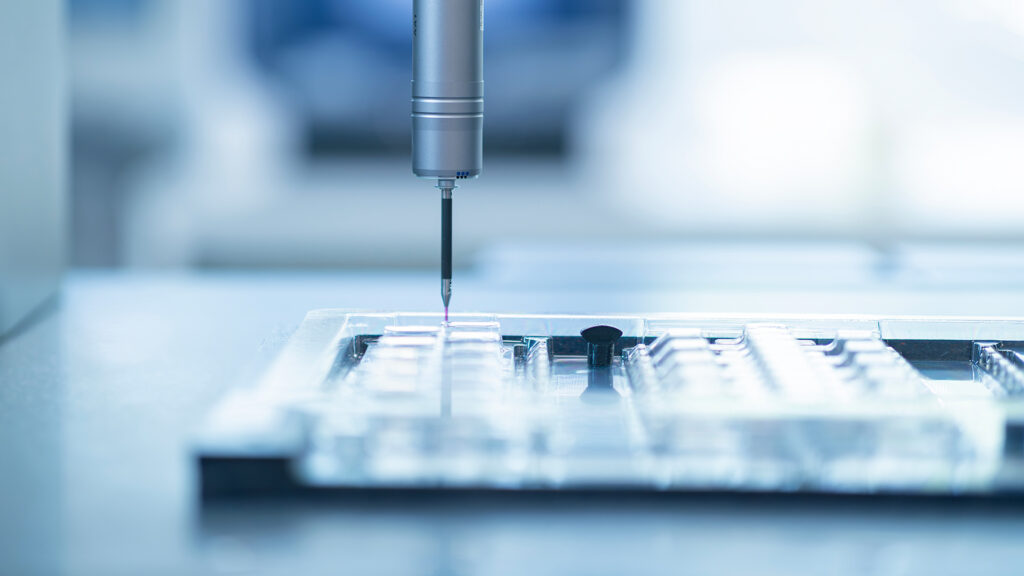
At our Rauma site, we have invested in a new coordinate measuring machine, CMM. It enables highly accurate three-dimensional product measurement from several directions and makes the measurement of complex products faster and more flexible. The equipment can measure with an accuracy of approximately four microns.
We have also strengthened our product measurement capabilities at our Kralovice site with a new CMM investment and by developing customised 3D scanning equipment for a customer solution.
Another area of development is 3D scanning. It can capture large amounts of dimensional data quickly and support product development, dimensional verification and reverse engineering.
Looking further ahead, machine learning and other new technologies may offer additional ways to analyse quality data and detect variation.
These developments are part of our broader investment in smart production and new technology. The technology itself, however, is not the point.
“We continuously develop our product measurement technologies, methods and equipment. What matters is what they enable: more accurate verification, earlier identification of risks, and more reliable quality for the customer.”
Quality goes beyond dimensions
Depending on the application, quality control can also include physical and material testing as well as particle and biological analyses carried out with laboratory partners.
This means verification can begin with the raw material and continue through production to the finished product and customer reporting.
For pharmaceutical and medical applications, the consequences reach particularly far. Reliable components and packaging help keep production processes running smoothly and minimise risks related to contamination or malfunction. Further along the chain, this can ultimately contribute to patient safety.
For us, product measurement is therefore not a separate technical step at the end of production. It is a way to demonstrate that we can deliver what has been agreed.
And as products, processes and requirements become more demanding, the ability to verify quality becomes even more valuable.
For you, the result is simple: greater confidence that the products you receive will meet the agreed specifications and perform reliably in their own processes.

Tommi Jäntti
Metrology & Development Engineer
tommi.jantti@satatuote.com
Tommi Jäntti is Metrology & Development Engineer at Satatuote, with over 25 years of experience in plastic product design and development. He leads Satatuote’s Metrology Lab and develops measurement and testing solutions that support customer projects and reliable quality assurance.